Triple Bottom Brewing proves that business can be a force for good
Aug. thirteen, 2019


When Triple Bottom Brewing opens at 915 Bound Garden, it will agree more than simply beer fermentation tanks—there will as well exist a washing machine.
You'll accept to observe somewhere else to do your laundry on days you stop by for a beer, though; the washing machine, along with a dryer and a shower, will be in the staff room, an endeavour to support employees who may not have that luxury at dwelling house. It's just one of the many ways the fledgling beer company is living upwardly to its name.
The "Triple Bottom" indicates that Tess Hart and Bill Popwell put themselves squarely in the triple lesser line movement for their business organisation—putting people, planet, and profit on an equal footing. " We desire to figure out how a business can be profitable, but as well be good," says Hart. And what better way to exercise that, than with something they honey: Beer.
"We saw an opportunity in arts and crafts breweries," Hart explains. "They are inherently places where people come together, simply that definition of who comes together hasn't expanded much."
Hart and Popwell are shooting to fully open the doors of Triple Lesser Brewing, now 2 and a half years in the making, right after Labor Solar day, with a soft opening the week earlier—though, as they've learned over the course of this journey, things don't ever follow your predictable timeline in beer making.
Hart and Popwell, her husband, both come from a background in community development, and that, too as their conversations about what community is and who fits into the traditional definition of it, sparked the idea for Triple Bottom Brewing. "We saw an opportunity in craft breweries," Hart explains. "They are inherently places where people come up together, but that definition of who comes together hasn't expanded much."
When you lot go to a arts and crafts brewery, the demographics of the customers is quite predictable: white millennials, likely college grads, maybe with a baby tagging along in a stroller. Breweries besides can serve equally an early on sign of gentrification, every bit middle- to upper-income young people flock to upwards-and-coming areas. Hart and Popwell are intentionally aiming for something different.

"Philadelphia has the fastest growing millennial population of whatever US city. At the same time, it has the highest poverty rate of the 10 largest U.S. cities," notes Hart. "We want to speak to both of those groups who come from a diverging identify and bring people together in a way that everyone feels welcome. We want to build some empathy and understanding beyond those groups." This, combined with Hart's connexion to the metropolis and the growing craft beer scene, led to Hart and Popwell'south like shooting fish in a barrel choice for the kickoff dwelling house for Triple Bottom.
Hart and Popwell grew up more than one,000 miles away from each other —Hart but outside of Philly in Haverford and Popwell in coastal Mississippi—merely they share the experience of beingness raised in a service-oriented family. Both of their moms were social workers; Popwell's parents are retired military and Hart's dad is a Haverford committeeman. They met equally undergraduates at Chocolate-brown University, and so moved on to D.C. together, where Popwell worked in community appointment for children'due south nonprofit KaBOOM! and Hart did community relations work first in the Senate and so as a consultant for economic evolution organizations.
In improver to sharing a career path and a drive for engaging with their communities, they both also just actually like beer —and breweries. " There is something special about visiting a brewery. Beau guests come in with a sense of curiosity about the fashion their beer is made that inspires them to be open minded towards others, to ask questions, and to learn," explains Hart. "We rarely felt then continued with complete strangers every bit nosotros did at breweries."
" I've seen also many companies treat their employees equally an afterthought. Not out of malice, information technology's just that other priorities come up," Carney says. " Our employees are the foundation this company is built on. They deserve to be paid well for the work they do."
During a particularly engaging visit to a brewery in Punta Arenas, Chile in 2014, where Hart and Popwell institute that people of all languages and backgrounds were seeking connection across geographical differences, they hatched their plan, picked a name, and gear up to work on a jobs program, all designed specifically for Philadelphia.

Triple Bottom recognizes itself as a fair take a chance business , in line with its first bottom line: people. This label is used widely by businesses that hire returning citizens, in recognition of the ofttimes insurmountable barriers to finding a job that having a criminal record can pose. Hart says that for Triple Bottom, being a fair chance concern means that "our team comes from an incredible variety of life and professional experiences," and leveraging that variety for Triple Bottom'south and its employees' success.
Hart and Popwell have filled just under one-half of their team with employees who have traditionally faced barriers to employment, such as a criminal record or homelessness. They rely on partners Project Dwelling , the Youth Sentencing and Reentry Project , and Mural Arts Philadelphia to refer such candidates to them, and the nonprofits will continue to offer wraparound services for the squad members throughout their employment with Triple Bottom. All employees will have access to professional person development, both of the beer brewing diverseness and behavioral skills, and all employees will have paid time off, an uncommon do good in the bar and restaurant industry and for part-time workers more generally. With the proper support, Hart and Popwell volition be able to hold all employees to the same high standards.

"Philly has this ridiculously high poverty charge per unit based on all of these social and systemic barriers that simply don't allow for equal admission to practiced jobs," says Hart. "In that location's a lot of people in Philadelphia who accept great skills and great bulldoze and deserve the hazard to take a great task that gives them the run a risk to prepare goals and reach them. We recognize that some of our squad members may have struggled with housing instability or getting child care, so the nonprofits are bachelor to provide that outside support."
Co-founder and caput brewer Kyle Carney says this mission is largely what drew him to partner with Hart and Popwell. " I've seen too many companies care for their employees as an afterthought. Non out of malice, it's just that other priorities come," he says. " We tin't forget about our people—information technology's right in that location in the name; it'south written into our business plan; it's the definition of who nosotros are equally a company. Our employees are the foundation this company is built on. They deserve to be paid well for the work they do."
"There'south a lot of people in Philadelphia who have great skills and great drive and deserve the hazard to have a great job that gives them the chance to set up goals and achieve them," Hart says.
Triple Bottom Brewing's second bottom line, the planet, means sourcing local ingredients when they can and minimizing the massive amount of waste that comes out of breweries.
The first part of this will largely be executed through partnering with local, environmentally witting producers of other food and drinkable products to sell at Triple Lesser. Vino from Karamoor Estate and cider from Unhurt & True Cider Co . will be on tap, and visitors can snack on the brewery'due south charcuterie boards with cheese from Di Bruno Bros , meat from 1732 Meats , and staff of life from Mighty Bread Co. and Lost Bread Company . "It's been fun to get to know other folks who are really taking care of their craft," explains Hart.
While the team would as well love to include local hops and malts in their beer, this has been tough because the local climate isn't ideal for growing hops. The Triple Lesser team hopes that a growing group of brewers who want to source locally may help build out the supply chain around beer in the region, assuasive them to source local ingredients in every attribute of their business.

Hart, who has a master'southward in Ecology Management from Yale, says one of the means they'll be reducing their footprint is past giving their spent grain, the grain leftover after the brewing process is complete, to local farmers to fertilize their state and to feed their steer. They will likewise salve and reuse the water and chemical mixture used to clean their brewing tanks rather than washing the chemicals into the city'southward water system after each clean, and would similar to eventually detect artists and makers in the metropolis who may desire to repurpose their grain numberless.
Triple Lesser's third bottom line is, of class, profit, and Hart and Popwell have hired Carney, who has 15 years of brewing feel, to create what'south at the centre of all of this: the beer. Carney says he and his co-founders are focusing on sessionable beer, an easy drink with a low ABV. "We're going for a more balanced, lower alcohol product for our core brands. That's not to say we won't take stronger, more than highly flavored offerings, it's just non our priority," he says. " They'll exist available as ane-offs and express release."
Triple Bottom will also always have a lager or something like it on tap. Hart says this is "in the spirit of making certain we're accessible to everyone, because people who might be intimidated by craft beer culture are probably lager drinkers."
Triple Bottom's beers are all named "in homage to the Philly community feel," according to Hart, such every bit their Cake Party Stake Ale. The Saison 122, a favorite pilot beer named for Carney's address when the grouping was yet brewing in his driveway, volition likewise announced on tap, though perhaps under a different proper name. Currently, the brewery's fermentation tanks are full of a West Coast style IPA, and volition adjacent be occupied by a lemon ginger wheat beer, both of which will be on tap opening calendar week.
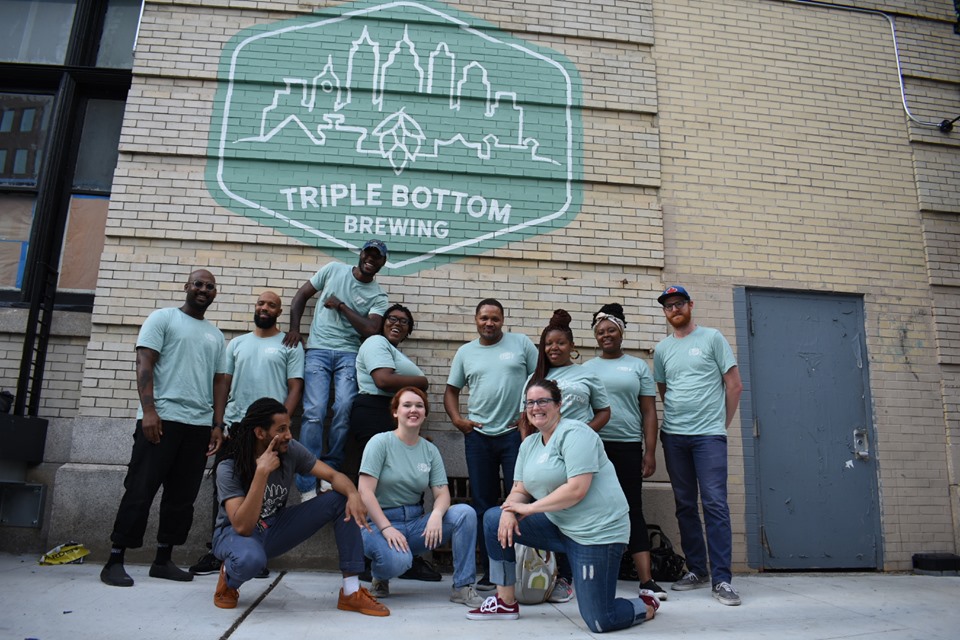
Triple Bottom Brewing first started fundraising for their venture via Indiegogo in December 2016. They somewhen raised $32,000, followed by boosted seed money via investors and loans, and signed a lease for the building in April of 2018. They besides launched a beer share for pre-order in December 2018, a monthly subscription modeled after a farmshare in which members option upwardly a drove of crowlers, 16 oz. 4-packs, and/or 750ml bottles every calendar month. Members, who pay $175 for vi months or $325 for twelve, likewise receive discounts on draft pours and merchandise and tin brainstorm picking up on opening day.
915 Bound Garden is seemingly the perfect home for a project like Triple Bottom Brewing; though information technology primarily served equally role space for the Reading Railroad, information technology contained a YMCA, complete with a bowling alley, and a welcoming room for immigrants new to Philadelphia—a space built on community and bringing people together.
The building's neighborhood and the changes happening within it also speaks to Triple Bottom Brewing'southward goals. The surface area effectually it is largely industrial, in a section of the city with low housing density and hazy boundaries that is sometimes referred to as Callowhill, but is also quite shut to Leap Garden. It's oftentimes described as a "donut hole" because information technology is surrounded by action—the Chinatown Northward, West Poplar, and Callowhill neighborhoods circumvolve information technology—just until recently not much was happening commercially within of it. Now it is home to Union Transfer, as well as a number of other restaurants and confined.
The building's owner, Arts & Crafts Holdings, is working on a revitalization of the surface area that has come up to be chosen "Spring Arts." Only irresolute the proper name of neighborhoods can be tricky and sometimes sorry for local residents, and Hart recognizes that change similar this tin can be tough on neighbors.
Hart and Popwell are eager to get input from neighbors on the space to maintain the inclusive spirit of their projection. " This area has been vital for a long time, information technology just hasn't been on people'south radars," says Hart. "We're excited to become to exist a part of bringing this neighborhood back to its potential; nosotros want to come across what's happening that is core to the community and how do nosotros lift that upwardly."
Correction: An earlier version of this story had the wrong name of Triple Bottom Brewery's new building; it is 915 Leap Garden. Also, the article misstated Arts & Craft Holdings' role; it owns the company.
Photo via Sola Onitiri 
Source: https://thephiladelphiacitizen.org/triple-bottom-brewing-philadelphia/
0 Response to "Triple Bottom Brewing proves that business can be a force for good"
Post a Comment